2026 to 2027Study
MSc Advanced Computer Science, University of Manchester
Expected completion September 2027. Machine learning, reasoning under uncertainty, cognitive robotics and computer vision, and data engineering.
Machine learning & software development
I design careful machine learning experiments, report what the evidence actually shows, and build the software around them.
First Class Honours software development graduate, now studying MSc Advanced Computer Science at the University of Manchester.
Final-year research · University of Malta
I built a reproducible pipeline to isolate what protein measurements add to models that already use RNA, copy number and mutation data. Different protein datasets cover different cell lines, so I tested each source separately and checked how missing measurements affected the results.
Proteogenomic Fusion Networks for Interpretable Cancer Drug Response Prediction
Supervised by Prof. Lalit Garg · June 2026 · 71 pages
ProCan raised mean ranking scores in all five model families. MS Gygi also added signal, while RPPA lowered mean scores in three of five. I used the combined union to test what happens when inputs are missing.
Change in mean Spearman after adding proteomics
| Source | ElasticNet | Extra Trees | Random Forest | Ridge | XGBoost |
|---|---|---|---|---|---|
| Combined union | −0.002 37% | +0.006 46% | +0.005 44% | +0.025 61% | +0.009 49% |
| MS Gygi | +0.005 45% | +0.018 53% | +0.019 57% | +0.019 57% | +0.017 53% |
| ProCan | +0.014 52% | +0.023 58% | +0.029 60% | +0.033 76% | +0.026 61% |
| RPPA | +0.000 1% | −0.006 36% | −0.003 38% | +0.003 23% | −0.008 37% |
The gains measure changes in how well the models ranked responses in cancer cell lines. Predictions for patients would require separate validation.
I benchmarked two ways to measure drug response before choosing the primary endpoint. Mean Spearman was about 0.117 for area under the dose-response curve (AUC) and about 0.024 to 0.025 for log fold-change (LFC). The absolute correlations were modest. I used AUC as the primary endpoint and kept LFC as a secondary check.
Read the evaluation chapter| Seed | AUC | LFC |
|---|---|---|
| 1584678 | 0.1167 | 0.0245 |
| 17052356 | 0.1168 | 0.0243 |
| 19537 | 0.1175 | 0.0241 |
I compared feature sets to estimate what each modality contributed. In the ElasticNet AUC analysis, RNA had the largest mean marginal contribution. Protein data added the next largest contribution in this setting.
| Data source | Contribution |
|---|---|
| RNA | 0.0711 |
| Proteomics | 0.0453 |
| Copy number | 0.0115 |
| Mutation | 0.0035 |
I compared classical imputation, denoising autoencoders, ReMasker, not-MIWAE and a task-aware joint model. I chose filtering thresholds by looking at how much data each one retained and how it changed downstream prediction.
| Proteomics source | Threshold |
|---|---|
| ProCan | 0.40 |
| MS Gygi | 0.30 |
| Combined union | 0.60 |
| RPPA | 0.50 |
0.213 mean Spearman across 10 folds
The strongest MS Gygi configuration used one seed. R² was negative, results varied by seed and validation scores transferred weakly to held-out data.
≈0.05 to 0.12–0.13 mean Spearman after revision
The revised model tested cases with all modalities present. Simple tabular baselines with the same leakage controls remained competitive.
I checked explanations with SHAP, Integrated Gradients, gates, attention and pathway enrichment. When they disagreed or highlighted missingness indicators, I reported that uncertainty.
I locked DepMap 25Q3, PRISM 24Q2 and STRING 12.0 with SHA-256 checksums so the same data could be used to repeat the experiments.
I joined on DepMap IDs, mapped ProCan records separately, averaged duplicates and audited unmapped rows.
I evaluated CCLE mass spectrometry, CCLE RPPA, ProCan and a combined union separately to expose differences in coverage and performance.
I used lineage-aware grouped cross-validation where feasible and fitted imputation, scaling, PCA and feature selection inside each training fold.
I registered all 15 combinations of RNA, copy number, mutation and proteomics so models could be compared with matched non-proteomic baselines where available.
I used Spearman to measure ranking and R² to check absolute predictions. Three fixed seeds let me check whether the patterns repeated.
I locked the DepMap release, PRISM responses and STRING protein interactions, keeping interaction edges with confidence of at least 0.7.
I imported cell metadata, RNA, copy number and mutation data alongside MS Gygi, RPPA and ProCan protein measurements.
I aligned DepMap, compound and HGNC-style gene identifiers across tables. I saved the cell and gene indexes, long-form PRISM response table and proteomics coverage records for later notebooks.
Arm A used MS Gygi, B used RPPA, C used ProCan and D used the combined union.
Track 1 compared feature sets on shared cell lines. Track 2 used masks to test incomplete modalities.
I fitted imputation, scaling, PCA, thresholds and feature transformations inside training folds. I compared AUC and LFC, and recorded Spearman, R², uplift, source rankings and seed stability.
The pipeline covered Ridge, XGBoost, multilayer perceptrons, ReMasker, not-MIWAE, STRING-GAT and gated attention. I saved predictions and metrics, and used SHAP, Integrated Gradients, attention and ranked genes as inputs to interpretation and pathway analysis. The thesis records the trade-offs, limitations and next experiments.
I tagged each run with the proteomics arm, endpoint, evaluation track, feature set, model, seed and fold.
These results describe preclinical cancer cell lines. Patient outcomes need separate validation. Missing measurements remain a source of uncertainty, and the graph and attention experiments used the five and ten drugs with the most response coverage, respectively.
I would validate on independent drug screens, test calibration and uncertainty, compare drug classes, and use paired and permutation tests to check how often the gains repeat.
Digital collectibles marketplace, group project
Developed the marketplace, cart and checkout backend logic, linking purchases and collectible ownership to user accounts. Built the collectibles API endpoints and seeding scripts, added structured logging, and resolved integration issues and merge conflicts.
Silent recording, 2 minutes 34 seconds. A written description follows.
Android fitness application
A Java app for workout, nutrition and progress tracking, built with MVVM components, Firebase Authentication, SQLite and asynchronous API calls.
Silent recording, 3 minutes 44 seconds. A written description follows.
Secure multiplayer puzzle game
A real-time multiplayer puzzle game with a dedicated TCP/UDP server and SSL/TLS communication.
Silent recording, 3 minutes 23 seconds. A written description follows.
PArL, a small programming language, built in Python
I built every stage of a compiler for PArL, from reading source text to generating code for a stack-based virtual machine, then extended the language with full array support. Each stage is a visitor over one shared syntax tree, which kept the pipeline modular and easy to extend.
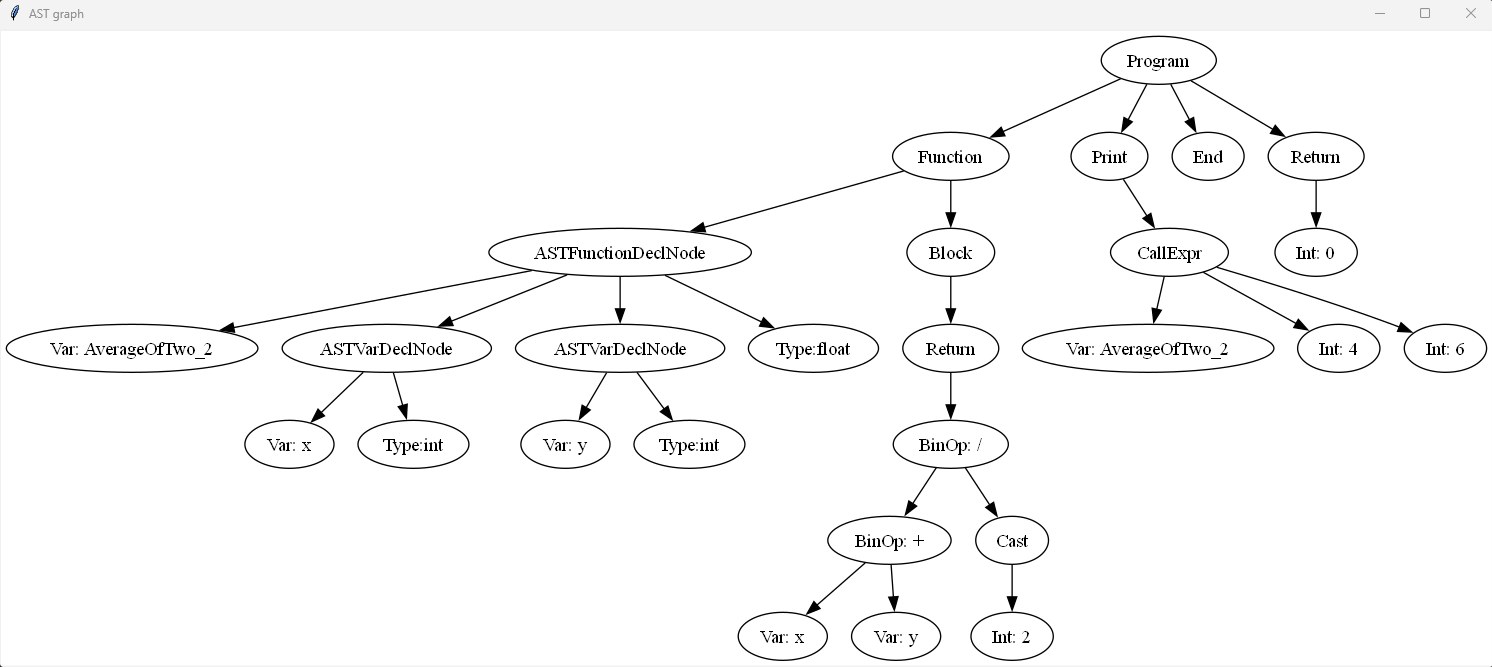
AverageOfTwo_2 with integer inputs x and y and a floating-point return type. Its return expression adds the inputs, then divides by two after a cast. The program calls the function with 4 and 6, prints the result, and returns 0.Tested on programs covering functions, loops, arrays, casts and operators.
Multilayer perceptron in Python and NumPy
A multilayer perceptron written from first principles, with no machine learning frameworks. I implemented forward propagation, backpropagation and both batch and stochastic gradient descent, then ran controlled experiments on network size, learning rate and training length, tracking training error and misclassified examples throughout.
End-to-end data analytics workflow in Jupyter
Took a real customer-churn problem from raw data to a validated neural network, using a dataset of roughly 7,000 telecom customers. I built it the way I approach research: understand the data first, compare against a baseline, and test every improvement before trusting it.
Expected completion September 2027. Machine learning, reasoning under uncertainty, cognitive robotics and computer vision, and data engineering.
Built a Python and Excel system that automates invoice processing, organising item descriptions, quantities, unit prices and purchase dates. It detects duplicates, compares historical prices, highlights price changes and summarises expenditure to support purchasing decisions and financial monitoring. I also developed the company website.
First Class Honours, finishing with a final year project on proteogenomic drug response prediction, supervised by Prof. Lalit Garg. Read about it.
Assisted with system preparation and configuration, and researched and shortlisted Zero Trust vendors to inform institutional security planning.
Theory and practical exercises in networking, operating systems, cryptography, cyber threats, security tools, legislation and frameworks.
Cyber threats and the tools used for detection and response.
A Levels in Mathematics, Computing and Marketing. Intermediates in English, Psychology and Systems of Knowledge.
Working knowledge
Multiple first-place finishes in competitive karate, and I represented Malta in Sicily.
I like to play the guitar, go to the gym and play basketball.
I experiment with Raspberry Pis and other hardware, including the M5Stack Cardputer-Adv with its StampS3A ESP32-S3FN8 module.
I set up a personal Fujitsu desktop running Ubuntu Server to host this portfolio in Docker. Cloudflare Tunnel carries web requests over a connection my server opens to Cloudflare, so I can offer public HTTPS access without port forwarding.